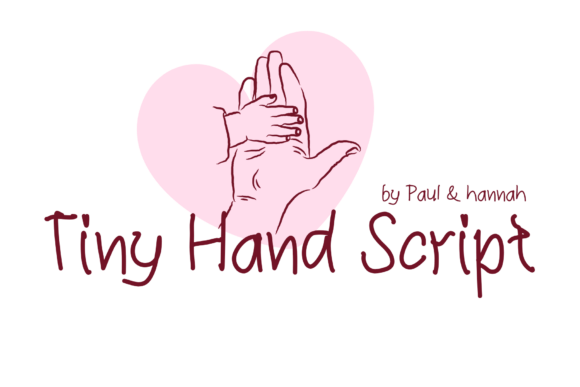
Tiny Hand Script: The Authenticity of a Child's Handwriting
There’s a specific quality in the handwriting of a young child that we, as adults, often lose: an unfiltered sincerity. It’s wobbly, imperfect, and entirely genuine. This is the exact feeling that the Tiny Hand Script typeface captures. It isn’t a generic, stylized calligraphy font; it is a handwritten font designed to mimic the charming, slightly uneven strokes of a four-year-old. In a world dominated by sterile sans serif font choices and rigid grid systems, this script font offers a breath of fresh air. It brings a warmth to modern typography that feels both nostalgic and incredibly current, making it a unique design asset for anyone looking to soften their message.
The Visual Character: More Than Just "Cute"
When you first look at Tiny Hand Script, the word "cute" comes to mind, but as a creative professional, you know that visual appeal goes deeper than that. The letterforms are organic. Unlike a premium font that has been vectorized into mathematical perfection, this typeface retains the natural inconsistencies of a human hand. The baseline isn’t perfectly straight, and the letter spacing varies slightly, mimicking the way a child concentrates on forming each letter. This gives the font a tactile quality, almost as if it were written with a thick crayon or a soft pencil.
This style is categorized as a display font, meaning it is designed to be used at larger sizes where these details can be appreciated. It stands in stark contrast to a traditional serif font used for body text. Where a serif font demands authority and structure, Tiny Hand Script invites the viewer in. It suggests that the message is personal and low-pressure. For brand identity projects, this visual language is powerful. It tells the audience that a brand is approachable, human, and perhaps a little playful.
Strategic Applications in Design and Branding
Knowing where to deploy a font like this is key to professional editorial design and packaging design. Because it is a highly stylized script font, it requires context to be effective. It shines brightest in projects that aim to evoke emotion rather than convey dense data.
For entrepreneurs and small business owners, particularly in the handmade or artisanal sectors, Tiny Hand Script is a natural fit. Imagine a bakery using it for their logo or a florist using it on their price tags. It instantly communicates "homemade" and "crafted with care." In packaging design, using this font for a "Thank You" note on the inside flap of a box creates a memorable unboxing experience for the customer. It transforms a commercial transaction into a personal interaction.
Bloggers and content creators can leverage this typeface for social media graphics. It works exceptionally well for pull quotes, Instagram story headers, or YouTube thumbnails where you want to highlight a specific, emotional point. It breaks up the monotony of standard web-safe fonts and adds a layer of personality to your digital presence. However, it is vital to treat it as an accent. A wall of text in this font would be illegible; used sparingly, it acts as a visual highlighter.
Readability and Visual Hierarchy
A common mistake in web design and print is prioritizing style over function. While Tiny Hand Script is a beautiful creative font, it is not a workhorse for long-form reading. Its strength lies in visual hierarchy. In a layout, you use weight, size, and style to guide the viewer's eye. A bold sans serif font might be your headline, but Tiny Hand Script serves as the sub-header or the callout quote that adds a pause in the visual rhythm.
When testing readability, consider the medium. On a high-resolution screen, the delicate loops and curves of the letters remain clear. In print, especially on textured paper stocks used for wedding invitations or stationery, the texture of the ink interacts beautifully with the font's design. However, on low-resolution screens or small mobile devices, the intricate details might muddy. Always test your font pairings at the intended output size. A good rule of thumb is to pair this handwritten style with a clean, geometric sans serif font. The contrast between the organic script and the structured sans-serif creates a balanced, professional look that doesn't feel chaotic.
Practical Considerations for Commercial Use
If you are considering Tiny Hand Script for a client project or your own business, you need to look at the technical specifications. As a commercial font, it is essential to review the licensing terms to ensure they cover your specific use case, whether it's for logo design, merchandise, or digital media.
Check the character set included in the file. A high-quality premium font often includes alternates and ligatures—different versions of the same letter that swap out automatically to prevent repetition, making the text look even more like genuine handwriting. Does it include multilingual support? If you are a publisher or working with an international audience, this is non-negotiable.
Furthermore, consider the file formats. For web design, you will likely need a WOFF or WOFF2 file, while print design requires OTF or TTF. Testing the font in your specific design software—whether it's Adobe Illustrator, Canva, or Figma—is a crucial step before finalizing a brand identity. You want to ensure that the kerning (the space between letters) is handled correctly so you aren't manually adjusting every word.
Adding Warmth to Your Next Project
Ultimately, typography is about voice. Choosing Tiny Hand Script is choosing a voice that is soft, honest, and endearing. It is a tool that allows designers, marketers, and hobbyists to step away from the rigid structures of corporate communication and connect on a human level.
Whether you are creating a scrapbook layout, designing a t-shirt line, or laying out a children's menu, this font provides a specific aesthetic that is difficult to replicate with standard typefaces. It reminds us that design doesn't always have to be serious or sharp; sometimes, the most effective way to communicate is with the wobbly, sincere charm of a child's hand. By integrating Tiny Hand Script into your toolkit, you gain the ability to instantly inject personality and warmth into any visual project.